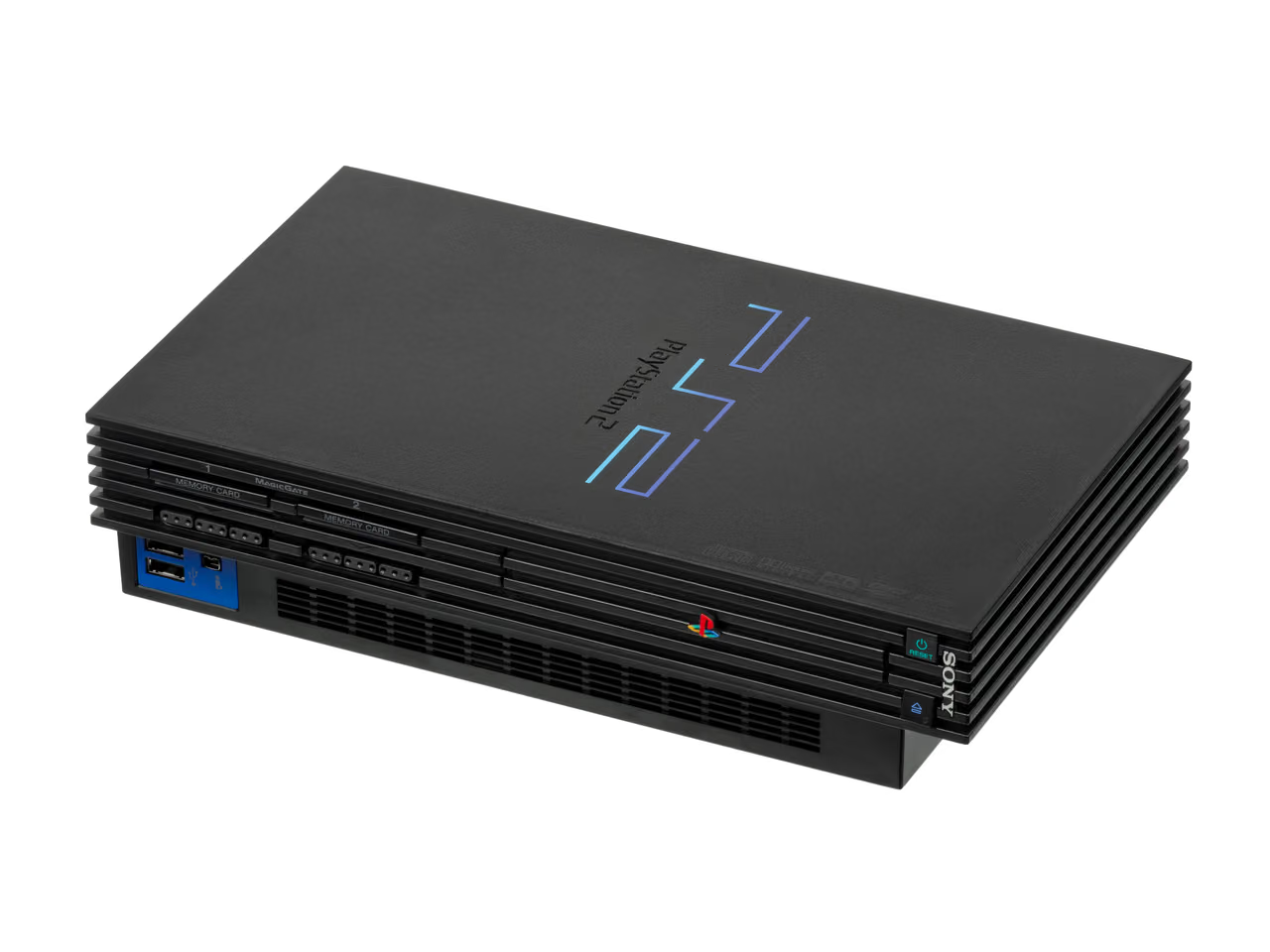
About this machine

The PlayStation 2 is the first record in this catalog where the graphics chip's memory is fifteen times faster than the console's main memory, on Sony's own figures. The machine's design follows from that asymmetry. Geometry runs on the Emotion Engine's two vector units, which is where its 6.2 GFLOPS mostly comes from; the Graphics Synthesizer only rasterizes, but does so against a frame buffer it never has to leave the die to reach. It has little room: 4 MiB holds the frame buffer, the Z buffer and whatever textures fit alongside them, so texture data streams in from main memory while drawing proceeds.

Its numbers come from Sony press releases rather than the developer manuals. The EE Overview, EE User's and GS User's manuals describe the caches, bus widths, vector units and memory map, but state neither the processor clock, the installed memory size nor a floating-point rate. SCEI published those three figures in a specification table a year before launch, then corrected the clock in a later release.

Configuration

Retail console

Component Role Count Clock Capacity
Emotion Engine 16 kB instruction cache, 8 kB data cache and 16 kB of scratchpad, per the 1999 specification. Main CPU 1 294.912 MHz Nominal clock
PlayStation 2 I/O Processor Drives the console's inputs and outputs, and becomes the whole machine when a PlayStation disc is playing. Co-processor 1 294.912 MHz Nominal clock
Graphics Synthesizer GPU 1 150 MHz Nominal clock
PlayStation 2 main memory (Direct RDRAM) Direct Rambus DRAM, reachable by the Emotion Engine. System memory 1 32 MiB
Graphics Synthesizer embedded DRAM On the Graphics Synthesizer die. Not addressable as main memory. Video memory 1 4 MiB

Figures for the whole machine

Sony PlayStation 2: system figures
Metric Value Evidence Basis Method Source
Clock frequency cpu 294.912 MHz Confirmed Vendor-rated Nominal clock Stated by the vendor Emotion Engine core clock. Identical in every region, the console having no video-standard-derived clock. Sony first published this clock as "300 MHz" a year before launch and as 294.912 MHz afterwards; see the conflict ledger. The figure also covers only the CPU: geometry runs on the two vector units and drawing on a separate chip with a clock of its own.
Clock frequency gpu 150 MHz Confirmed Vendor-rated Nominal clock Stated by the vendor Graphics Synthesizer clock, as stated in Sony's specification release. Sony states 150 MHz and derives the chip's own bandwidth figures from it, so the two agree; accounts outside Sony's documentation frequently give 147.456 MHz instead. No source cited here states that value, so it is not recorded.
Memory capacity whole-system 32 MiB Confirmed Derived Design capacity Computed here from figures the vendor stated Main memory of the retail console. Adds 1 memory-capacity figure obtained by design-capacity. Left out: 4 MiB embedded in the Graphics Synthesizer (on the drawing chip’s own die and unreachable from the processor). A total is only as trustworthy as the decision about what belongs in it, so both the terms and the exclusions are named records.
Memory bandwidth whole-system 3.2 GB/s Confirmed Derived Theoretical peak Computed here from figures the vendor stated The bus between the processor and the memory it works in. Adds 1 memory-bandwidth figure obtained by theoretical-peak. Left out: 48 GB/s inside the Graphics Synthesizer (the drawing chip’s own embedded memory, which the processor cannot read or write). A total is only as trustworthy as the decision about what belongs in it, so both the terms and the exclusions are named records.
Rated power consumption whole-system 79 W Confirmed Vendor-rated Rated power Stated by the vendor Rating printed in the instruction manual of the SCPH-39001 console, on a 120 V, 60 Hz supply. A rating rather than a measurement: no workload is stated, and the console draws less than this at idle and while playing a disc. It applies to one revision of the hardware among many, and the metric forbids ratios for exactly that reason.

Figures for its components

Emotion Engine
Metric Value Evidence Basis Method Source
Peak FP32 rate cpu 6.2 GFLOP/s Confirmed Vendor-rated Theoretical peak Stated by the vendor Whole chip: the FPU coprocessor together with vector units VU0 and VU1, which hold nine floating-point multiply-add units and three dividers between them. Sony states the rate without an operation mix, a precision or a benchmark, so it is a vendor peak rather than an achieved result. It is not comparable with the Dreamcast's floating-point figure, which Sega derived from a specific matrix-multiplication workload.
PlayStation 2 main memory (Direct RDRAM)
Metric Value Evidence Basis Method Source
Memory capacity memory 32 MiB Confirmed Vendor-rated Design capacity Stated by the vendor Main memory fitted to the console. The Emotion Engine can address 256 MB, which development hardware used and retail machines never did. The release writes "32 MB", meaning 32 MiB. The Graphics Synthesizer's 4 MiB is separate and unreachable from here, so the two are never added.
Memory bandwidth memory 3.2 GB/s Confirmed Theoretical Theoretical peak Stated by the vendor Peak transfer rate of the Direct Rambus channel between main memory and the Emotion Engine. A bus maximum, not a rate any workload sustains. Rambus reaches it with a narrow channel at a very high transfer rate, which makes it more sensitive to access pattern than a wide, slow bus of the same nominal figure.
Graphics Synthesizer embedded DRAM
Metric Value Evidence Basis Method Source
Memory capacity memory 4 MiB Confirmed Vendor-rated Design capacity Stated by the vendor Embedded DRAM on the Graphics Synthesizer die, holding the frame buffer, the Z buffer and textures in one address space. The release writes "4MB", meaning 4 MiB. The figure is quoted from the 2003 description of the merged Emotion Engine and Graphics Synthesizer chip; the embedded memory was not resized when the two dies were combined.
Memory bandwidth memory 48 GB/s Confirmed Theoretical Theoretical peak Stated by the vendor Peak transfer rate of the Graphics Synthesizer's embedded DRAM across its 2560 bit bus at 150 MHz. A bus maximum. The 2560 bit are not one bus but three ports — separate read and write paths for the frame and Z buffers plus a texture path — so no single operation can consume the whole figure.
Memory bus width memory 2560 bit Confirmed Vendor-rated Design capacity Stated by the vendor The total width of the ports into the embedded DRAM, summed. It is an on-die figure and has no counterpart on a console whose graphics memory is external.

Derived figures and comparisons

Computed by this project rather than read from a source, and recomputed from their inputs on every build.

70×

Formula
a ÷ b ratio v1
Inputs
  • nvidia-h100-memory Memory bandwidth: 3.35 TB/s
  • ps2-gs-edram Memory bandwidth: 48 GB/s
Rounding
half-up , 2 significant digits

Compares memory-bandwidth at memory scope, obtained by theoretical-peak. Valid only within this comparability group, and reported to 2 significant digits — the precision of the least precise input. At least one input is a theoretical peak, which is an upper bound rather than an achieved result.

15×

Formula
a ÷ b ratio v1
Inputs
  • ps2-gs-edram Memory bandwidth: 48 GB/s
  • ps2-main-rdram Memory bandwidth: 3.2 GB/s
Rounding
half-up , 2 significant digits

Compares memory-bandwidth at memory scope, obtained by theoretical-peak. Valid only within this comparability group, and reported to 2 significant digits — the precision of the least precise input. At least one input is a theoretical peak, which is an upper bound rather than an achieved result.

33 554 432 B

Formula
a + b + … sum v1
Inputs
  • ps2-main-rdram Memory capacity: 32 MiB
Rounding
none , 8 significant digits

Adds 1 memory-capacity figure obtained by design-capacity. Left out: 4 MiB (on the drawing chip’s own die and unreachable from the processor). A total is only as trustworthy as the decision about what belongs in it, so both the terms and the exclusions are named records.

3 200 000 000 B/s

Formula
a + b + … sum v1
Inputs
  • ps2-main-rdram Memory bandwidth: 3.2 GB/s
Rounding
none , 10 significant digits

Adds 1 memory-bandwidth figure obtained by theoretical-peak. Left out: 48 GB/s (the drawing chip’s own embedded memory, which the processor cannot read or write). A total is only as trustworthy as the decision about what belongs in it, so both the terms and the exclusions are named records.

Conflicting sources

Clock frequency

  1. 294.912 MHz accepted

    "New Semiconductor Specification" table, 2003-04-21: "Clock frequency: 294.912MHz". Issued three years after launch, describing shipping silicon.

  2. 300 MHz

    次世代プレイステーション概要仕様書, 1999-03-02: クロック周波数 300MHz. Issued a year before launch, in the release that first disclosed the console's specifications.

Editorial decision 2026-07-29

The two figures are the same clock stated to different precision rather than a disagreement about the hardware. 294.912 MHz is 36.864 MHz — the PlayStation 2's audio-derived reference — multiplied by eight, and it is what the console's other clocks divide down from; 300 MHz is not a frequency any crystal in the machine produces. The 1999 release rounds elsewhere in the same table, giving the input/output processor as "33.8/37.5 MHz" where the lower figure is the original PlayStation's 33.8688 MHz, so a round "300" in a pre-launch announcement is what that document does with a number, not what Sony built. The later release is also the one describing hardware that shipped rather than hardware still a year away.

Editorial notes

The release date is editorial context: the cited specification release is dated March 1999 and states only an intention to launch during the following fiscal year. Sony's polygon figures, 66 million per second of geometry on the Emotion Engine and 75 million per second of drawing on the Graphics Synthesizer, are not recorded because the catalog has no polygon-rate metric. The rated power consumption is the SCPH-39001 revision's; later revisions drew considerably less, and the 2003 single-chip release puts the launch pair of chips at 37 W between them.

Sources

Back to top