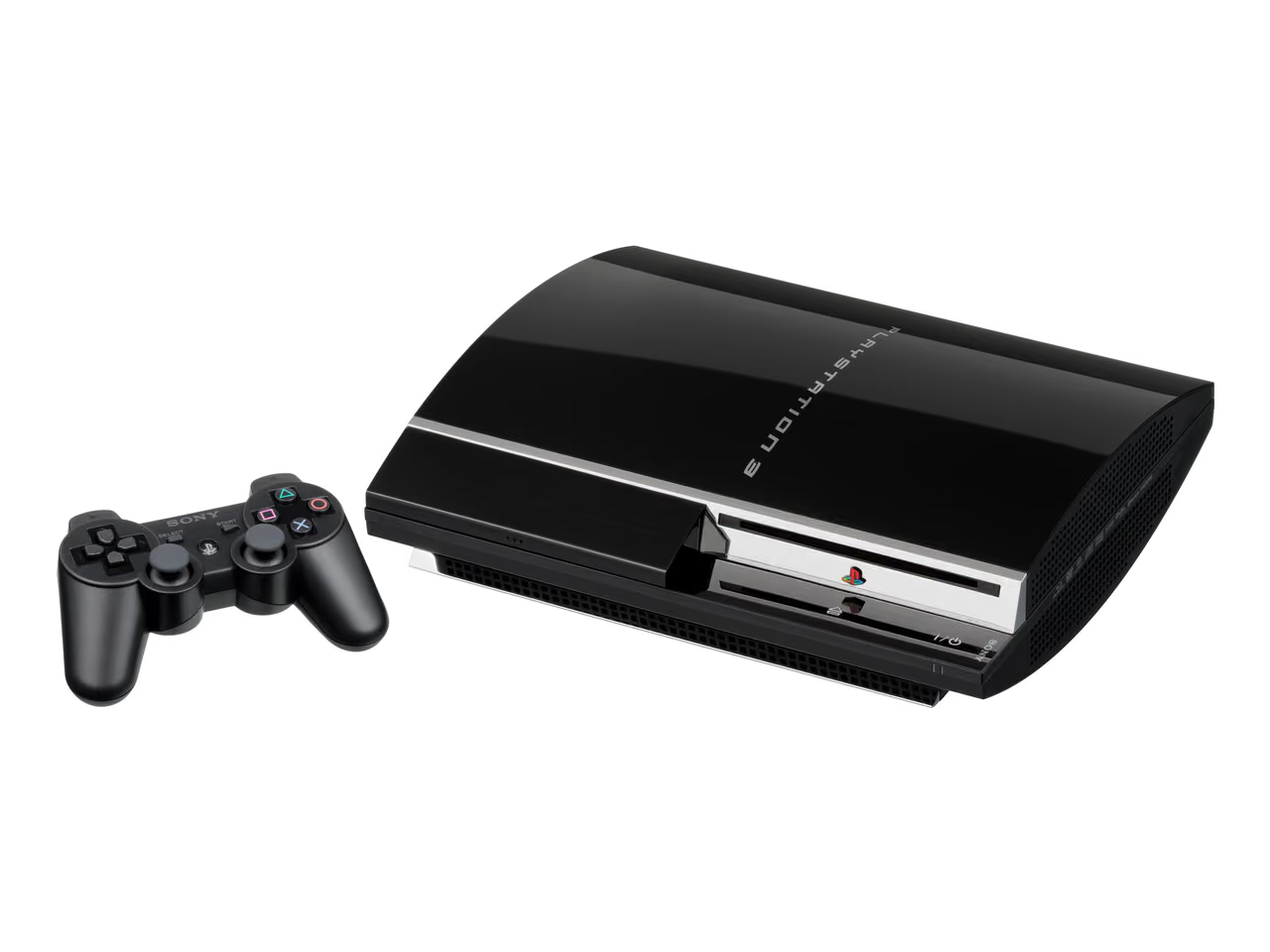
About this machine

Every figure on this record comes from one of two Sony specifications, and which of the two decides how far the figure can be trusted.

The announcement of May 2005 is a full table: a 3.2 GHz PowerPC core, seven SPEs at the same clock, 218 GFLOPS between them, an RSX at 550 MHz claimed at 1.8 TFLOPS, and 2 TFLOPS for the system. The launch specification of May 2006 describes the console that shipped, and states none of it. It names the Cell processor and the RSX without a clock for either, gives no floating-point figure at all, and repeats only the memory: 256 MB of XDR and 256 MB of GDDR3.

So the two memory capacities are approved and everything else is provisional. Not because any particular number is doubted, but because a company that has finished the hardware declined to restate what it said before it had. Those figures are recorded as pre-launch evidence. That does not move them into a comparability group of their own: an announced clock is still a nominal clock, and it stands in the same row as the clock of a machine that shipped, where a reader can see both. What it does is keep them provisional, and a provisional record never feeds an automatic multiplier.

Configuration

Launch console

Component Role Count Clock Capacity
Cell Broadband Engine One PowerPC core with 512 kB of L2 cache, plus seven usable SPEs each with 256 kB of local store. Clock from the 2005 announcement. Main CPU 1 3.2 GHz Nominal clock
RSX Reality Synthesizer Clock from the 2005 announcement; the launch specification gives none. GPU 1 550 MHz Nominal clock
PlayStation 3 main memory (XDR DRAM) System memory 1 256 MiB
PlayStation 3 video memory (GDDR3) Video memory 1 256 MiB

Figures for the whole machine

Sony PlayStation 3: system figures

provisional A figure marked provisional is recorded but not accepted: its evidence is unsettled. It may rely on one source, an unconfirmed announcement, or a digit read from a damaged scan. The reason appears under the figure. The catalog shows the figure but never uses it in a multiplier. How records are judged.

Metric Value Evidence Basis Method Source
Clock frequency cpu provisional 3.2 GHz Confirmed Vendor-rated Nominal clock Stated by the vendor, before the hardware shipped PowerPC core and all SPEs, per the announcement of May 2005, eighteen months before the console shipped. Announced rather than confirmed: Sony's launch specification names the processor without a clock. It stands beside clocks recorded from shipped machines, because a nominal clock is the same quantity whenever it was published, but it stays provisional until a source describing shipped hardware states one, and a provisional figure never feeds a multiplier. Reviewed again against the instruction manual printed for the console that shipped (CECHA01, 2006): its specification table names the Cell and the RSX without a frequency for either and both memories without a transfer rate, so no post-launch Sony document corroborates this figure and it stays provisional.
Clock frequency gpu provisional 550 MHz Confirmed Vendor-rated Nominal clock Stated by the vendor, before the hardware shipped RSX, per the announcement of May 2005. Announced rather than confirmed, and the graphics processor is the part of the console Sony described least: the launch specification names the RSX and stops. Provisional on that ground, so it is shown beside other nominal clocks but never divided into one. Reviewed again against the instruction manual printed for the console that shipped (CECHA01, 2006): its specification table names the Cell and the RSX without a frequency for either and both memories without a transfer rate, so no post-launch Sony document corroborates this figure and it stays provisional.
Memory capacity whole-system 256 MiB Confirmed Derived Design capacity Computed here from figures the vendor stated Main memory of the console as it shipped. Adds 1 memory-capacity figure obtained by design-capacity. Left out: 256 MiB of video memory (the RSX’s own pool, which the processor cannot spend on its own work). A total is only as trustworthy as the decision about what belongs in it, so both the terms and the exclusions are named records. A third Sony document states the same two capacities, and it is the first written for a buyer holding the machine rather than for the press: the specification table in the CECHA01 instruction manual.
Memory bandwidth whole-system provisional 25.6 GB/s Confirmed Derived Theoretical peak Computed here from figures the vendor stated, before the hardware shipped The bus between the Cell processor and the XDR memory it works in. Adds 1 memory-bandwidth figure obtained by theoretical-peak. Left out: 22.4 GB/s of video memory (the RSX’s own pool, reached by the processor only across a separate interface). A total is only as trustworthy as the decision about what belongs in it, so both the terms and the exclusions are named records. Reviewed again against the instruction manual printed for the console that shipped (CECHA01, 2006): its specification table names the Cell and the RSX without a frequency for either and both memories without a transfer rate, so no post-launch Sony document corroborates this figure and it stays provisional.
Rated power consumption whole-system 380 W Confirmed Vendor-rated Rated power Stated by the vendor Rating printed in the instruction manual supplied with the CECHA01 console, the 60 GB model launched in November 2006. A supply rating, not a measurement: no workload is stated and none is implied. It took the manual in the box to find it: neither the specification Sony published before launch nor the launch release itself states a wattage, and the manual is tied to this console rather than to a later, smaller revision by the dimensions and mass it prints beside the figure, which match Sony’s own launch release exactly.

Figures for its components

Cell Broadband Engine

provisional A figure marked provisional is recorded but not accepted: its evidence is unsettled. It may rely on one source, an unconfirmed announcement, or a digit read from a damaged scan. The reason appears under the figure. The catalog shows the figure but never uses it in a multiplier. How records are judged.

Metric Value Evidence Basis Method Source
Peak FP32 rate cpu provisional 218 GFLOP/s Confirmed Vendor-rated Theoretical peak Stated by the vendor, before the hardware shipped "Total floating point performance" of the Cell processor — the PowerPC core with its VMX unit and all seven SPEs — per the announcement of May 2005. Recorded as single precision on the strength of the SPEs being single-precision units, which is an editorial reading and not a citation: the source states no precision. Provisional on that ground as well as on being a pre-launch figure. Reviewed again against the instruction manual printed for the console that shipped (CECHA01, 2006): its specification table names the Cell and the RSX without a frequency for either and both memories without a transfer rate, so no post-launch Sony document corroborates this figure and it stays provisional.
RSX Reality Synthesizer

provisional A figure marked provisional is recorded but not accepted: its evidence is unsettled. It may rely on one source, an unconfirmed announcement, or a digit read from a damaged scan. The reason appears under the figure. The catalog shows the figure but never uses it in a multiplier. How records are judged.

Metric Value Evidence Basis Method Source
Peak FP32 rate gpu provisional 1.8 TFLOP/s Confirmed Vendor-rated Theoretical peak Stated by the vendor, before the hardware shipped "Floating point performance" of the RSX, per the announcement of May 2005. The weakest figure on this record. No precision, no shader-unit count and no operations-per-cycle are stated, so it cannot be reconciled with the 550 MHz quoted beside it, and no later Sony document repeats it. It is recorded because the source states it and withheld from every automatic multiplier because nothing about it can be checked. Reviewed again against the instruction manual printed for the console that shipped (CECHA01, 2006): its specification table names the Cell and the RSX without a frequency for either and both memories without a transfer rate, so no post-launch Sony document corroborates this figure and it stays provisional. It also cannot be read as the same claim as the PlayStation 4's 1.84 TFLOP/s: the PlayStation 4's reconstructs exactly from the compute units its own source names, counting the fused multiply-add each shader lane issues per cycle, and this one reconstructs from nothing. They share a comparability group because both are a vendor's theoretical peak for a graphics processor, which is as far as the group can see: it cannot tell that the two are counting different operations. A search for a checkable figure to set against this one found nothing usable: the rates that circulate for the RSX disagree with each other by more than a factor of two and every one of them traces back to a wiki or a forum, so there is no A source and no pair of agreeing B sources to record a conflict against.
PlayStation 3 main memory (XDR DRAM)

provisional A figure marked provisional is recorded but not accepted: its evidence is unsettled. It may rely on one source, an unconfirmed announcement, or a digit read from a damaged scan. The reason appears under the figure. The catalog shows the figure but never uses it in a multiplier. How records are judged.

Metric Value Evidence Basis Method Source
Memory capacity memory 256 MiB Confirmed Vendor-rated Design capacity Stated by the vendor Main memory attached to the Cell processor, in the console Sony launched. Both releases write "256MB", meaning 256 MiB. The RSX's 256 MiB is a separate pool, so the console's memory is never one figure of 512 MiB. A third Sony document states the same two capacities, and it is the first written for a buyer holding the machine rather than for the press: the specification table in the CECHA01 instruction manual.
Memory bandwidth memory provisional 25.6 GB/s Confirmed Vendor-rated Theoretical peak Stated by the vendor, before the hardware shipped "System Bandwidth — Main RAM", per the announcement of May 2005. A bus figure from a pre-launch table, and one the launch specification does not repeat. The same table quotes the RSX's access to this memory separately, at 20 GB/s writing and 15 GB/s reading, so the processor is not the only claimant on the 25.6. Reviewed again against the instruction manual printed for the console that shipped (CECHA01, 2006): its specification table names the Cell and the RSX without a frequency for either and both memories without a transfer rate, so no post-launch Sony document corroborates this figure and it stays provisional.
PlayStation 3 video memory (GDDR3)

provisional A figure marked provisional is recorded but not accepted: its evidence is unsettled. It may rely on one source, an unconfirmed announcement, or a digit read from a damaged scan. The reason appears under the figure. The catalog shows the figure but never uses it in a multiplier. How records are judged.

Metric Value Evidence Basis Method Source
Memory capacity memory 256 MiB Confirmed Vendor-rated Design capacity Stated by the vendor Video memory attached to the RSX, in the console Sony launched. Both releases write "256MB", meaning 256 MiB. External to the RSX rather than embedded in it, unlike the PlayStation 2's graphics memory. A third Sony document states the same two capacities, and it is the first written for a buyer holding the machine rather than for the press: the specification table in the CECHA01 instruction manual.
Memory bandwidth memory provisional 22.4 GB/s Confirmed Vendor-rated Theoretical peak Stated by the vendor, before the hardware shipped "System Bandwidth — VRAM", per the announcement of May 2005. A bus figure from a pre-launch table. Worth reading beside the PlayStation 2's graphics memory, which was sixty-four times smaller and twice this fast, although the multiplier is refused: this figure is provisional, having been announced before the console shipped and never restated afterwards. Reviewed again against the instruction manual printed for the console that shipped (CECHA01, 2006): its specification table names the Cell and the RSX without a frequency for either and both memories without a transfer rate, so no post-launch Sony document corroborates this figure and it stays provisional.

Derived figures and comparisons

Computed by this project rather than read from a source, and recomputed from their inputs on every build.

268 435 456 B

Formula
a + b + … sum v1
Inputs
  • ps3-xdr Memory capacity: 256 MiB
Rounding
none , 9 significant digits

Adds 1 memory-capacity figure obtained by design-capacity. Left out: 256 MiB (the RSX’s own pool, which the processor cannot spend on its own work). A total is only as trustworthy as the decision about what belongs in it, so both the terms and the exclusions are named records.

25 600 000 000 B/s

Formula
a + b + … sum v1
Inputs
  • ps3-xdr Memory bandwidth: 25.6 GB/s
Rounding
none , 11 significant digits

Adds 1 memory-bandwidth figure obtained by theoretical-peak. Left out: 22.4 GB/s (the RSX’s own pool, reached by the processor only across a separate interface). A total is only as trustworthy as the decision about what belongs in it, so both the terms and the exclusions are named records.

Editorial notes

The release date is editorial context as the catalog defines it, but it is unusually well attested here: the launch specification is titled with the date. The 2005 announcement's "System Floating Point Performance: 2 TFLOPS" is not recorded because it sums a CPU figure and a GPU figure into one number. The catalog has no metric that spans both scopes. No derived claim compares the two memory bandwidths, although both are stated, because the ratio formula declines provisional inputs.

Sources

Back to top