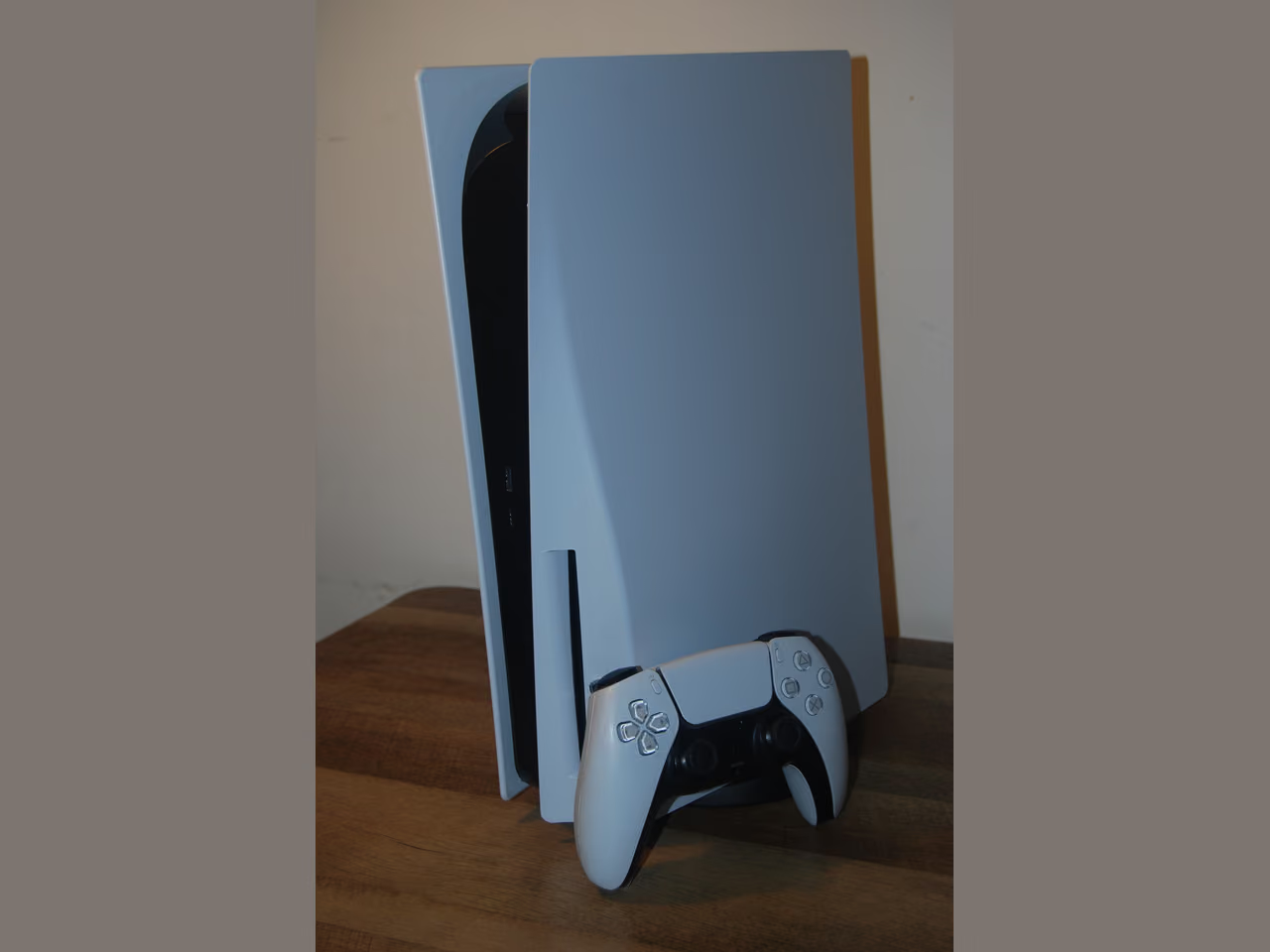
About this machine

This record completes a line of five consoles from the same maker, released from 1994 to 2020 and described in five different vocabularies.

The PlayStation and PlayStation 2 are described by frequency. The PlayStation 3 adds a floating-point rate. The PlayStation 4 drops frequency entirely and gives core counts and teraflops. The PlayStation 5 states frequencies but also says they are not constants. "Variable frequency, up to 3.5 GHz" is a different quantity from a nominal clock: it is a ceiling reached when power and heat allow. It cannot share a row with the PlayStation 2's 294.912 MHz, because the two figures answer different questions. This machine's nominal clock is therefore recorded as not-applicable, and its ceiling is recorded under a method shared with GeForce boost clocks.

Everything here is provisional because Sony's only specification table for this console went up eight months before it shipped and has been edited since. The graphics rate now reads 10.3 TFLOP/s where it once read 10.28, and the compute-unit count it once carried is gone. A figure from a document that is still changing remains provisional.

Configuration

Launch console

Component Role Count Clock Capacity
PlayStation 5 custom processor (CPU section) 8 cores, 16 threads. The frequency is a ceiling: Sony specifies it as variable. Main CPU 1 not applicable Nominal clock 3.5 GHz Peak clock
PlayStation 5 custom processor (GPU section) Also a ceiling, and also variable. Sony states no compute-unit count. GPU 1 not applicable Nominal clock 2.23 GHz Peak clock
PlayStation 5 unified GDDR6 memory Sony's own heading is "System Memory": one pool for the processor and the graphics engine. Unified memory 1 16 GiB shared
PlayStation 5 internal SSD Read decimally. 825 is not a power of two and was never meant to be read as one. Storage 1 825 GB

Figures for the whole machine

Sony PlayStation 5: system figures

provisional A figure marked provisional is recorded but not accepted: its evidence is unsettled. It may rely on one source, an unconfirmed announcement, or a digit read from a damaged scan. The reason appears under the figure. The catalog shows the figure but never uses it in a multiplier. How records are judged.

Metric Value Evidence Basis Method Source
Clock frequency cpu provisional 3.5 GHz Confirmed Vendor-rated Peak clock Stated by the vendor, before the hardware shipped Eight Zen 2 cores at a variable frequency, per Sony's specification table of March 2020. A ceiling, not a rate the machine holds: Sony's words are "Variable frequency, up to 3.5 GHz", and how often the processor reaches it depends on what the graphics engine is drawing at the same time. It shares a comparability group with the GeForce cards' boost clocks, which are the same kind of claim, and shares none with the fixed clocks of the four PlayStations before it. Provisional because the only document that states it went up eight months before the console shipped and has been edited since.
Clock frequency gpu provisional 2.23 GHz Confirmed Vendor-rated Peak clock Stated by the vendor, before the hardware shipped The RDNA 2 graphics engine at a variable frequency, per Sony's specification table of March 2020. "Variable frequency, up to 2.23 GHz", printed in the same cell as the teraflops figure it is meant to explain, but with no compute-unit count beside it, so the two cannot be checked against each other. Provisional on the same grounds as every other figure from this table.
Storage capacity storage provisional 825 GB Confirmed Vendor-rated Design capacity Stated by the vendor, before the hardware shipped The fitted internal solid-state drive of the launch console. Storage, not memory, and read decimally: 825 is not a power of two, and reading it in the binary convention this catalog applies to memory would silently turn it into a different number. The 5.5 GB/s read bandwidth Sony prints beside it is a storage transfer rate and is not recorded as a memory bandwidth.
Memory bandwidth whole-system provisional 448 GB/s Confirmed Derived Theoretical peak Computed here from figures the vendor stated, before the hardware shipped One bus for everything: the processor cores and the graphics engine share this memory rather than owning separate pools. Adds 1 memory-bandwidth figure obtained by theoretical-peak. Nothing in the catalog is left out of it. A total is only as trustworthy as the decision about what belongs in it, so both the terms and the exclusions are named records.
Rated power consumption whole-system 350 W Confirmed Vendor-rated Rated power Stated by the vendor Launch chassis CFI-1015A, electrical rating 100 V–240 V, 3.55 A–1.5 A. A nameplate maximum rather than a measured draw. Recorded from the safety guide because the specification table Sony published for this console states no power figure at all. Later PlayStation 5 revisions carry different ratings.
2 documented absences
Sony PlayStation 5: system figures: documented absences
Metric Value Evidence Basis Method Source
Clock frequency cpu not applicable Sony specifies the processor as running at a variable frequency with a ceiling. There is no fixed frequency to state, which is a fact about the machine rather than a gap in the sources. Not stated Vendor-rated Nominal clock Stated by the vendor Not-applicable rather than unknown. The PlayStation 4 has a nominal clock that Sony declines to state; this machine does not have one. "Variable frequency" is a design statement, so a fixed specified frequency is a quantity the hardware lacks, and the figure Sony does give is recorded beside this one under a method of its own.
Clock frequency gpu not applicable Sony specifies the graphics engine as running at a variable frequency with a ceiling, so it has no fixed nominal clock either. Not stated Vendor-rated Nominal clock Stated by the vendor Not-applicable for the same reason as the processor's, and recorded separately because the two frequencies vary independently: on this machine the graphics engine and the cores share a power budget, so neither ceiling implies the other is being reached.

Figures for its components

PlayStation 5 custom processor (GPU section)

provisional A figure marked provisional is recorded but not accepted: its evidence is unsettled. It may rely on one source, an unconfirmed announcement, or a digit read from a damaged scan. The reason appears under the figure. The catalog shows the figure but never uses it in a multiplier. How records are judged.

Metric Value Evidence Basis Method Source
Peak FP32 rate gpu provisional 10.3 TFLOP/s Confirmed Vendor-rated Theoretical peak Stated by the vendor, before the hardware shipped The RDNA 2 graphics engine at its ceiling frequency of 2.23 GHz, per Sony's specification table of March 2020. Recorded as single precision, which the source does not state: the same editorial reading the PlayStation 3's and PlayStation 4's figures carry, and the same reason for holding it provisional. It is also a rate quoted at a frequency the machine reaches rather than holds, and with no compute-unit count to check it against.
PlayStation 5 unified GDDR6 memory

provisional A figure marked provisional is recorded but not accepted: its evidence is unsettled. It may rely on one source, an unconfirmed announcement, or a digit read from a damaged scan. The reason appears under the figure. The catalog shows the figure but never uses it in a multiplier. How records are judged.

Metric Value Evidence Basis Method Source
Memory bandwidth memory provisional 448 GB/s Confirmed Vendor-rated Theoretical peak Stated by the vendor, before the hardware shipped Bandwidth of the unified GDDR6 memory, per Sony's specification table of March 2020. A bus maximum, comparable with every other theoretical bandwidth in the catalog and with none of the benchmarked ones. Stated eight months before the console shipped, in a table that has been revised since.
Memory capacity whole-system provisional 16 GiB Confirmed Vendor-rated Design capacity Stated by the vendor, before the hardware shipped Unified system memory, shared by the processor cores and the graphics engine. Sony writes "GDDR6 16GB", meaning 16 GiB. Recorded at whole-system scope rather than memory scope because it is the machine's memory: like the PlayStation 4 and unlike the three consoles before it, there is no second pool this figure excludes.

Derived figures and comparisons

Computed by this project rather than read from a source, and recomputed from their inputs on every build.

448 000 000 000 B/s

Formula
a + b + … sum v1
Inputs
  • ps5-gddr6 Memory bandwidth: 448 GB/s
Rounding
none , 12 significant digits

Adds 1 memory-bandwidth figure obtained by theoretical-peak. Nothing in the catalog is left out of it. A total is only as trustworthy as the decision about what belongs in it, so both the terms and the exclusions are named records.

Editorial notes

The release date is editorial context: the cited table predates the console by eight months and states no date. The digital edition, which differs only in the optical drive, is not recorded as a second configuration because it carries no different figure. Three things in Sony's table are deliberately not recorded: the SSD's 5.5 GB/s read bandwidth, which is a storage rate rather than the memory-bandwidth metric; the disc capacity, which describes a medium rather than the machine; and the audio engine, which the catalog has no metric for. No power figure is recorded because Sony publishes none.

Sources

Back to top