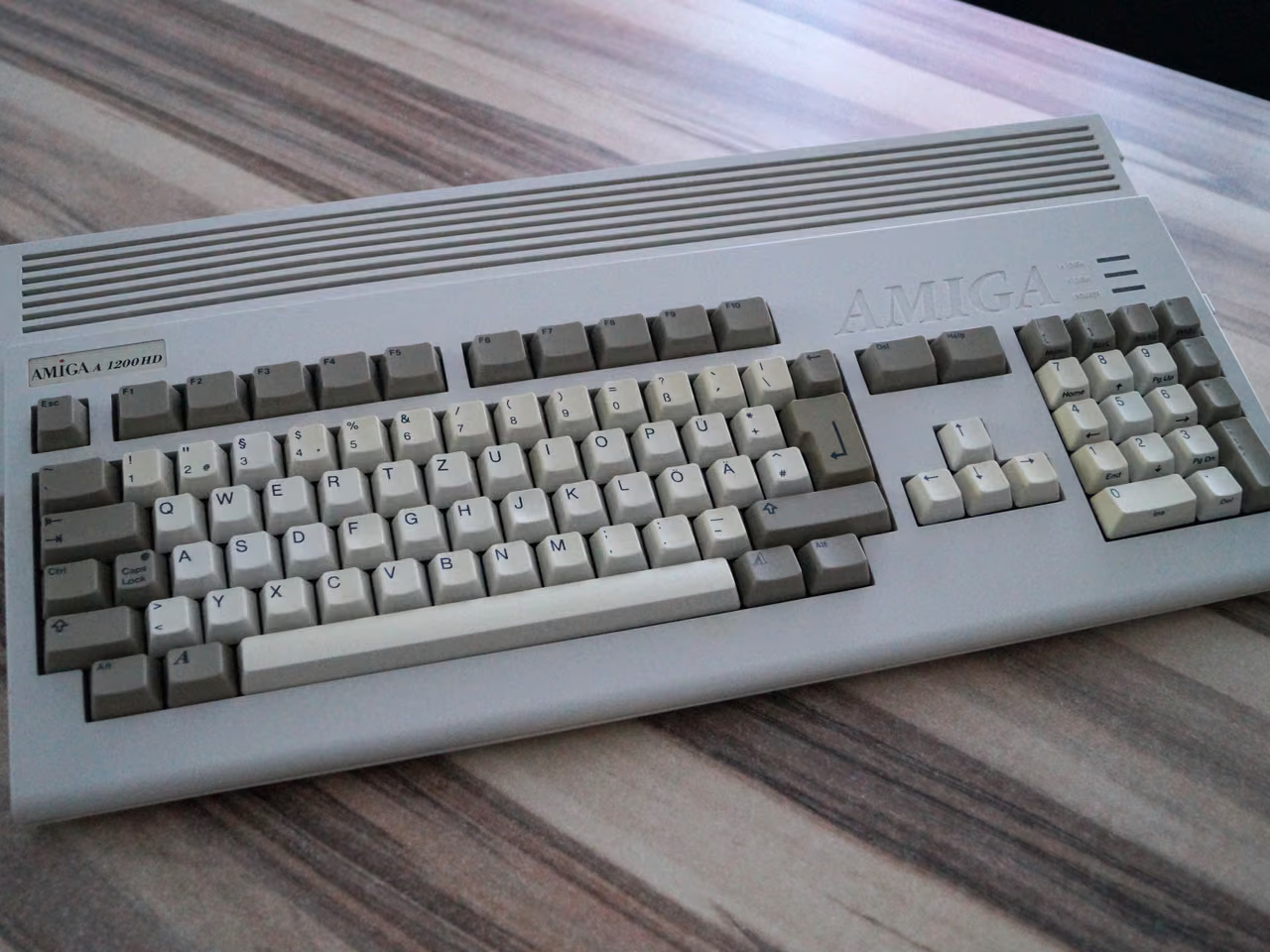
About this machine

The Amiga 1200 is a useful counterpart to the Amiga 500 because the two differ in more than clock rate. The 68EC020 runs at roughly twice the 500's frequency. Both clocks derive from the same video crystals, halved rather than quartered. It also has a 32 bit data path where the 68000 had 16, an instruction cache, and single-access operations where the 68000 needed two. Comparing the machines on megahertz alone would miss most of what changed. Chip memory is 32 bit wide and organized as 256K by 32, and the AGA chipset reaching it replaced the Original Chip Set. Floating point remained absent by default; the socket for a 68881 or 68882 was factory-fit only.

Configuration

PAL

Europe

Component Role Count Clock Capacity
Motorola MC68EC020 Half the 28.37516 MHz PAL base crystal. The service manual's functional-specification section states 14.18 MHz instead; see the conflict ledger. Main CPU 1 14.19 MHz Nominal clock
Amiga AGA chipset (Alice, Lisa, Paula) GPU 1 unknown Nominal clock
Amiga 1200 Chip memory Shared with the AGA chipset. Shipped as 1 MB, later configured with 2 MiB as standard. System memory 1 2 MiB shared
Amiga 1200 Kickstart ROM System memory 1 512 KiB

NTSC

North America

Component Role Count Clock Capacity
Motorola MC68EC020 Half the 28.63636 MHz NTSC base crystal. Main CPU 1 14.32 MHz Nominal clock
Amiga AGA chipset (Alice, Lisa, Paula) GPU 1 unknown Nominal clock
Amiga 1200 Chip memory System memory 1 2 MiB shared
Amiga 1200 Kickstart ROM System memory 1 512 KiB

Figures for the whole machine

Commodore Amiga 1200: system figures
Metric Value Evidence Basis Method Source
Clock frequency cpu 14.32 MHz Confirmed Vendor-rated Nominal clock Stated by the vendor NTSC machines. Half the 28.63636 MHz NTSC base crystal, which gives 14.31818 MHz exactly. Both the appendix A table and the functional specification agree on this figure once the scan's habit of reading 3 as 8 is corrected against the crystal frequency.
Clock frequency cpu 14.19 MHz Confirmed Vendor-rated Nominal clock Stated by the vendor PAL machines. Half the 28.37516 MHz PAL base crystal, which gives 14.18758 MHz exactly. The same manual states 14.18 MHz in its functional-specification section. The conflict ledger records why 14.19 was accepted. Note also that this is roughly twice the Amiga 500's clock while the machine is considerably more than twice as capable, because the data path doubled as well.
Memory capacity whole-system 2 MiB Confirmed Derived Design capacity Computed here from figures the vendor stated Chip memory fitted to the base machine, which is all of its writable memory. Adds 1 memory-capacity figure obtained by design-capacity. Left out: 512 KiB of Kickstart ROM (read-only firmware, not memory the machine can write to). A total is only as trustworthy as the decision about what belongs in it, so both the terms and the exclusions are named records.
Rated power consumption whole-system 23 W Confirmed Vendor-rated Rated power Stated by the vendor The switching supply the machine ships with, from the technical specification table. A supply rating, not a draw: nothing here was measured, and the manual says the A1200 shares the supply with the A600, so the figure describes what Commodore fitted rather than what this machine uses. Comparable in kind with the Apollo Guidance Computer’s 70 W and the Mac mini’s 150 W, and with nothing anybody put a meter on, which is why the metric forbids ratios.
2 documented absences
Commodore Amiga 1200: system figures: documented absences
Metric Value Evidence Basis Method Source
Clock frequency gpu unknown The service manual gives the processor clock and the crystal it is divided from, and no frequency for the AGA chipset. Not stated Vendor-rated Nominal clock Stated by the vendor Unknown for the same reason as the Amiga 500’s, one generation later: the documents describe the custom chips by what they can reach and how fast they can be fed, never by a clock of their own.
Memory bandwidth memory unknown The service manual states the data path width and the memory fitted, and no transfer rate. Not stated Vendor-rated Theoretical peak Stated by the vendor Unknown. The A1200 widened the path to Chip memory to 32 bit, which is the change that mattered most for graphics on this machine, and it is recorded as a width because a width is what the manual states.

Figures for its components

1 documented absence
Motorola MC68EC020: documented absences
Metric Value Evidence Basis Method Source
Peak FP32 rate cpu not applicable No floating-point hardware on the die. The Amiga 1200 has a socket for a 68881 or 68882 coprocessor, but the manual records it as factory-installed only, so a stock machine has none and any floating-point figure would describe software on an integer ALU. Not stated Vendor-rated Theoretical peak Stated by the vendor
Amiga 1200 Chip memory
Metric Value Evidence Basis Method Source
Memory capacity memory 2 MiB Confirmed Vendor-rated Design capacity Stated by the vendor The maximum Chip memory, which the manual records as the standard configuration by the time it was written. Machines shipped with 1 MB on the motherboard. Chip memory only: what the AGA chipset can reach. Fast memory added in the CPU slot or the PCMCIA slot is invisible to the graphics hardware and is not counted here.
Amiga 1200 Kickstart ROM
Metric Value Evidence Basis Method Source
Memory capacity memory 512 KiB Confirmed Vendor-rated Design capacity Stated by the vendor Kickstart 3.0 mask ROM, organized as 128K by 32 bit.

Derived figures and comparisons

Computed by this project rather than read from a source, and recomputed from their inputs on every build.

2 097 152 B

Formula
a + b + … sum v1
Inputs
  • amiga-1200-chip-ram Memory capacity: 2 MiB
Rounding
none , 7 significant digits

Adds 1 memory-capacity figure obtained by design-capacity. Left out: 512 KiB (read-only firmware, not memory the machine can write to). A total is only as trustworthy as the decision about what belongs in it, so both the terms and the exclusions are named records.

Conflicting sources

Clock frequency

  1. 14.19 MHz accepted

    Appendix A, page A-1, "Technical specifications", clock speed row: "NTSC: 14.32 MHz / PAL: 14.19 MHz". This is the manual's dedicated specifications table.

  2. 14.18 MHz

    Page 5-3, "A1200/A1200HD functional specification", Features, CPU: "14.18 MHz 68EC020 PAL". The same manual, in a summary list rather than a specifications table.

Editorial decision 2026-07-29

The PAL Amiga base crystal is 28.37516 MHz, so half of it is 14.18758 MHz exactly. Rounded to four significant digits that is 14.19; 14.18 is what truncation gives. The specifications table in appendix A is also the more authoritative of the two statements, being the manual's dedicated technical-specification section rather than a summary feature list. There is a further reason to distrust the 14.18 reading: the scanned text of page 5-3 confuses 3 with 8 elsewhere in the same list, rendering the NTSC clock as "14.82 MHz" and the data path as "82-bit", so the discrepancy may be an artifact of the scan rather than a disagreement Commodore ever printed. Either way the accepted figure is the one that follows from the crystal.

Editorial notes

The release date is editorial context; the cited service manual documents the hardware without dating the launch. The scanned text of that manual is unreliable in places. It confuses 3 with 8, so every figure taken from it was cross-checked against the base crystal frequencies in the Amiga Hardware Reference Manual.

Sources

  • Amiga 1200 Service Manual Commodore Business Machines · tier A · Appendix A "Technical specifications", page A-1; A1200/A1200HD functional specification, page 5-3
Back to top