About this machine

This record keeps processor, graphics and installed memory as distinct components so that their quantities retain their own meaning.

Configuration

Retail hardware

Component Role Count Clock Capacity
Intel Pentium III Main CPU 1 733 MHz Nominal clock —
NVIDIA NV2A GPU 1 233 MHz Nominal clock —
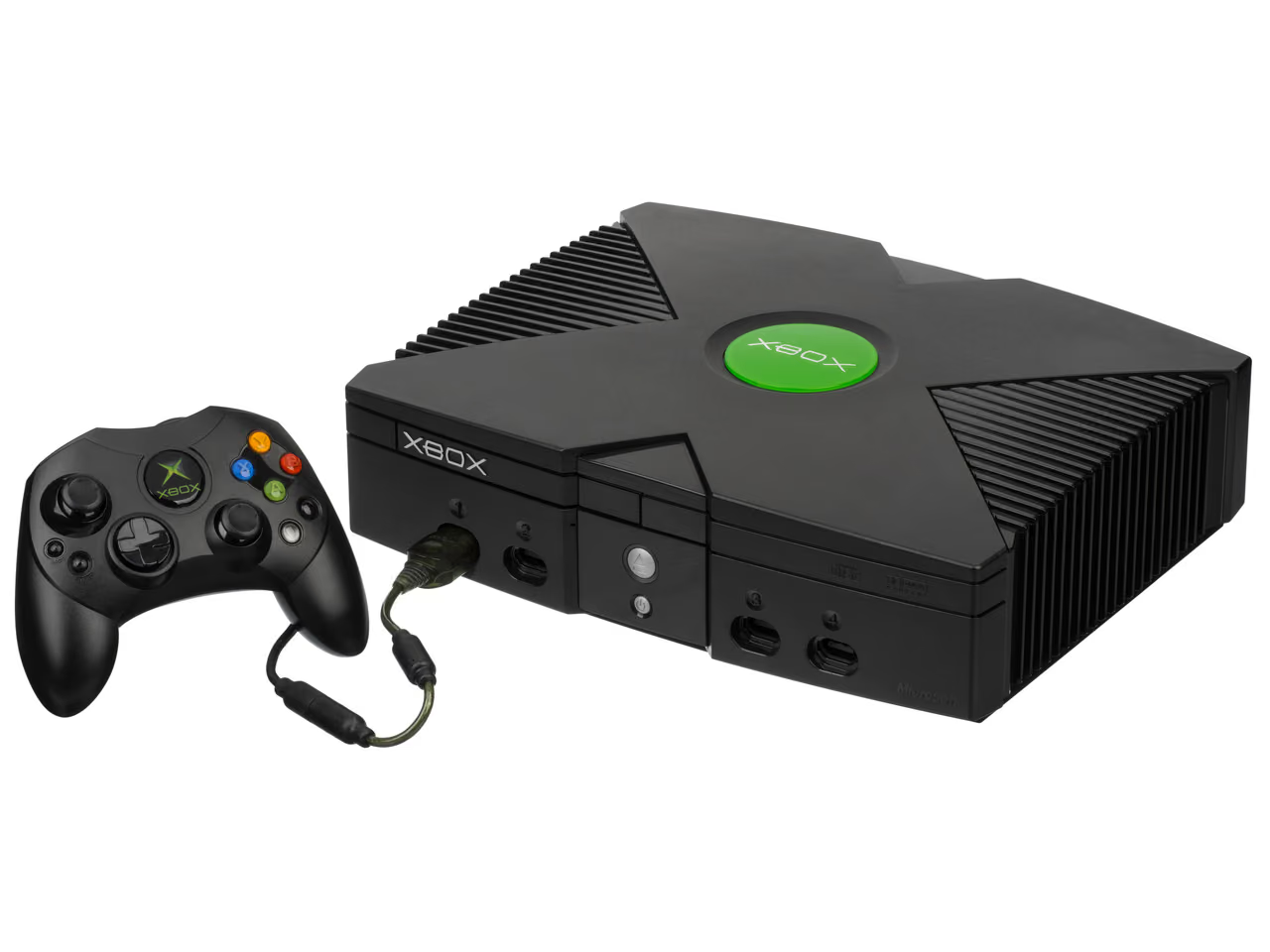
Microsoft Xbox unified memory Unified memory 1 — 64 MiB shared

Figures for the whole machine

Microsoft Xbox: system figures

provisional A figure marked provisional is recorded but not accepted: its evidence is unsettled. It may rely on one source, an unconfirmed announcement, or a digit read from a damaged scan. The reason appears under the figure. The catalog shows the figure but never uses it in a multiplier. How records are judged.

Metric Value Evidence Basis Method Source
Clock frequency cpu 733 MHz Confirmed Vendor-rated Nominal clock Stated by the vendor Microsoft's retrospective specification identifies the CPU model and clock.
Clock frequency gpu 233 MHz Confirmed Vendor-rated Nominal clock Stated by the vendor Microsoft's retrospective specification gives the NV2A graphics clock.
Memory bandwidth memory 6.4 GB/s Confirmed Theoretical Theoretical peak Published independently64 MB unified DDR SDRAM at 200 MHz DDR across NVIDIA's 128 bit TwinBank interface, shared by CPU and NV2A. A theoretical maximum for the whole machine, shared between processor and graphics; both sources say the CPU can take about 1 GB/s of it. Microsoft published no bandwidth figure, so this rests on two independent analyses that reach the same number by different routes: one from NVIDIA's stated design, one from the memory parts found in a retail console.
Memory capacity whole-system provisional 67 108 864 B Confirmed Derived Design capacity Computed here from figures the vendor stated Adds 1 memory-capacity figure obtained by design-capacity. Nothing in the catalog is left out of it. A total is only as trustworthy as the decision about what belongs in it, so both the terms and the exclusions are named records.
2 documented absences
Microsoft Xbox: system figures: documented absences
Metric Value Evidence Basis Method Source
Peak FP32 rate gpu provisional unknown The registered technical source does not yet provide a standalone GPU FP32 rate with a stated precision and method. Not stated Vendor-rated Theoretical peak Stated by the vendor Provisional record for microsoft-xbox: the primary technical source is registered, but page-level transcription and independent review are pending.
Rated power consumption whole-system provisional unknown The registered technical source does not yet provide a comparable whole-system rated power figure. Not stated Vendor-rated Rated power Stated by the vendor Provisional record for microsoft-xbox: the primary technical source is registered, but page-level transcription and independent review are pending.

Figures for its components

Microsoft Xbox unified memory
Metric Value Evidence Basis Method Source
Memory capacity memory 64 MiB Confirmed Vendor-rated Design capacity Stated by the vendor Microsoft's retrospective specification identifies the 64 MB DDR main-memory configuration.

Derived figures and comparisons

Computed by this project rather than read from a source, and recomputed from their inputs on every build.

67 108 864 B

Formula
a + b + … sum v1
Inputs
  • microsoft-xbox-ram Memory capacity: 64 MiB
Rounding
none , 8 significant digits

Adds 1 memory-capacity figure obtained by design-capacity. Nothing in the catalog is left out of it. A total is only as trustworthy as the decision about what belongs in it, so both the terms and the exclusions are named records.

The game that came with half the consoles

Cultural and historical context, cited but not evidence. No figure in the tables above rests on any of it.

The Strong National Museum of Play inducted Halo: Combat Evolved with the class of 2017, and its record makes the point through a ratio rather than a total. When Microsoft entered the console market in 2001, Halo sold alongside fifty percent of all systems, which is what led critics to call it the console’s killer app.

The record is also worth reading for what the game did without. It had one of the stronger multiplayer modes of its time, but it arrived before Xbox Live, so players who wanted to face each other had to wire up a local area network to do it.

The museum ends on two details about names. The artificial intelligence character Cortana was well enough liked that Microsoft later attached the name to a virtual assistant. And the game had been introduced to the public as a Macintosh title: Steve Jobs presented it at the 1999 Macworld Expo, a year before Microsoft bought the developer Bungie and made it exclusive to its own console.
Sources

Back to top