Handheld
Nintendo Game Boy
A 1.05 MHz handheld with 8192 B work RAM and a monochrome tile-and-sprite LCD controller.
- Manufacturer
- Nintendo
- Released
- April 1989
- Region
- Japan
- Record status
- provisional
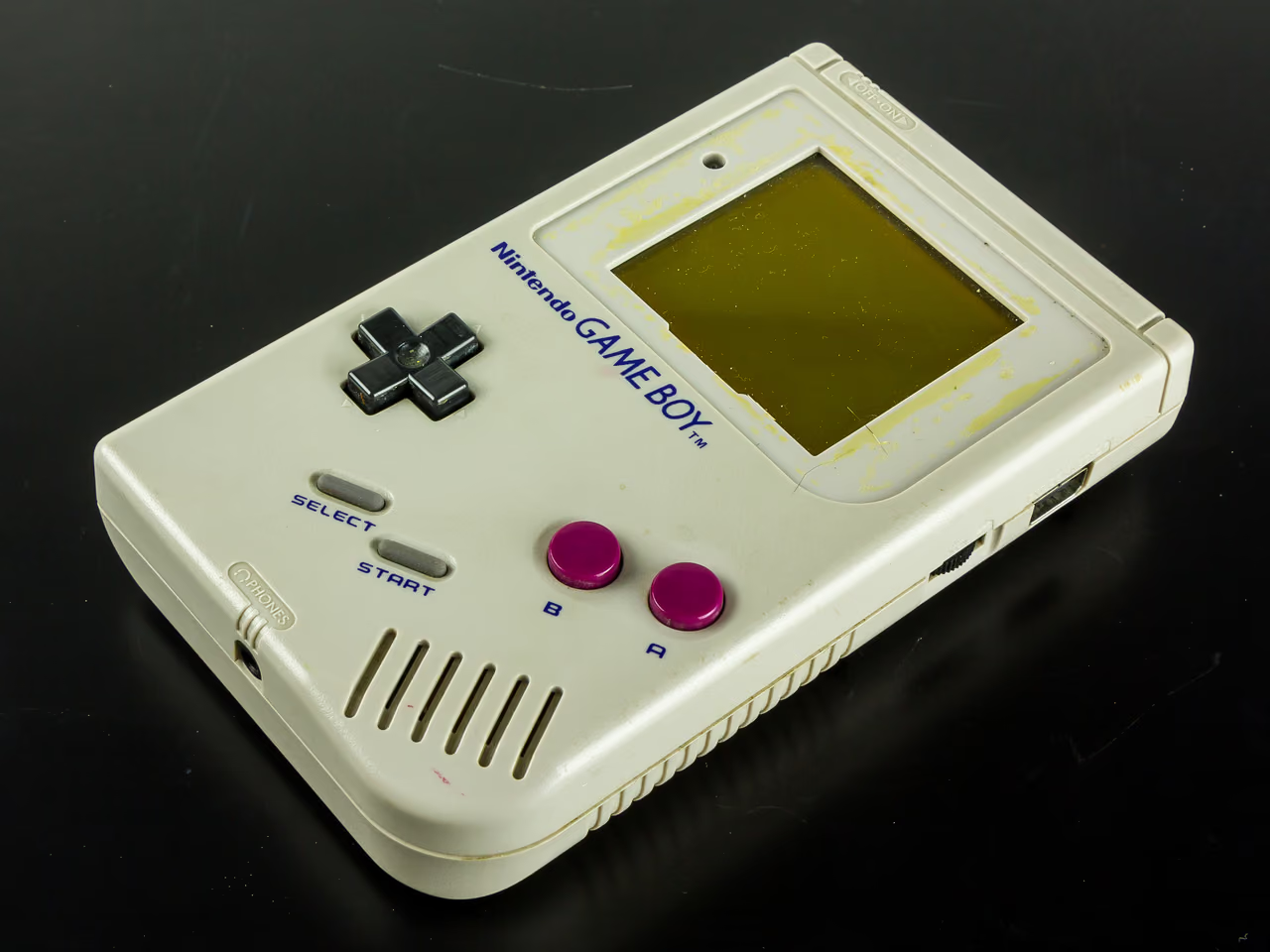
A Nintendo Game Boy, model DMG-01, switched off. The yellowing is the age of the plastic rather than anything done to the machine.

About this machine
This entry covers Nintendo's original Game Boy retail handheld. Its compact monochrome design made a useful baseline for the later portable systems in this catalog.
Configuration
Original retail handheld
| Component | Role | Count | Clock | Capacity |
|---|---|---|---|---|
| Sharp LR35902 | Main CPU | 1 | 1.05 MHz Nominal clock | — |
| Game Boy LCD controller | GPU | 1 | unknown Nominal clock | — |
| Game Boy work RAM | System memory | 1 | — | 8192 B |
Figures for the whole machine
provisional A figure marked provisional is recorded but not accepted: its evidence is unsettled. It may rely on one source, an unconfirmed announcement, or a digit read from a damaged scan. The reason appears under the figure. The catalog shows the figure but never uses it in a multiplier. How records are judged.
| Metric | Value | Evidence | Basis | Method | Source |
|---|---|---|---|---|---|
| Clock frequency cpu provisional | 1.05 MHz | Reported | Vendor-rated | Nominal clock Stated by the vendor Nintendo calls this the DMG system operating frequency. It is not substituted with a different oscillator-clock convention. |
5 documented absences
| Metric | Value | Evidence | Basis | Method | Source |
|---|---|---|---|---|---|
| Clock frequency gpu provisional | unknown The reviewed manual gives no separate LCD-controller clock. | Not stated | Vendor-rated | Nominal clock Stated by the vendor The Game Boy Programming Manual gives the CPU system clock and the source oscillator, but no separate clock for the LCD controller. | |
| Memory bandwidth memory provisional | unknown The reviewed manual gives no memory bandwidth or bus width. | Not stated | Vendor-rated | Theoretical peak Stated by the vendor The Game Boy Programming Manual describes display RAM and DMA transfers, but does not specify a memory-bus width or bandwidth. | |
| Storage capacity storage provisional | not applicable Game cartridges are removable media and their ROM capacity varies by title; no cartridge capacity is part of the base console. | Not stated | Vendor-rated | Design capacity Stated by the vendor | |
| Memory capacity whole-system provisional | unknown Work RAM alone omits display RAM and other internal storage. A comparable total needs a derived claim with stated inclusions and exclusions. | Not stated | Vendor-rated | Design capacity Stated by the vendor Nintendo's programming manual lists work RAM and display RAM separately. The work-RAM figure does not establish the console's total installed RAM. | |
| Rated power consumption whole-system provisional | unknown The reviewed manual gives no whole-system power rating. | Not stated | Vendor-rated | Rated power Stated by the vendor The Game Boy Programming Manual lists battery and adapter power sources, but no whole-system power rating. |
Figures for its components
1 documented absence
| Metric | Value | Evidence | Basis | Method | Source |
|---|---|---|---|---|---|
| Peak FP32 rate cpu provisional | not applicable This console CPU has no integrated floating-point execution unit. | Not stated | Vendor-rated | Theoretical peak Stated by the vendor Provisional record for nintendo-game-boy: the cited primary manual is registered, but its page-level transcription and independent review are still pending. |
1 documented absence
| Metric | Value | Evidence | Basis | Method | Source |
|---|---|---|---|---|---|
| Peak FP32 rate gpu provisional | not applicable This is a tile, sprite or scanline graphics unit, not a floating-point processor; it executes no FP32 operations. | Not stated | Vendor-rated | Theoretical peak Stated by the vendor Provisional record for nintendo-game-boy: the cited primary manual is registered, but its page-level transcription and independent review are still pending. |
provisional A figure marked provisional is recorded but not accepted: its evidence is unsettled. It may rely on one source, an unconfirmed announcement, or a digit read from a damaged scan. The reason appears under the figure. The catalog shows the figure but never uses it in a multiplier. How records are judged.
| Metric | Value | Evidence | Basis | Method | Source |
|---|---|---|---|---|---|
| Memory capacity memory provisional | 8192 B | Reported | Vendor-rated | Design capacity Stated by the vendor Nintendo's comparison table gives this capacity for the original DMG Game Boy. |
Editorial notes
Game Pak ROM is removable storage and is not included in writable memory.
Tetris in the box, Pokémon on the cable
Two Game Boy games are in The Strong National Museum of Play’s World Video Game Hall of Fame, and the museum’s records credit both of them to the hardware around the screen rather than to the screen.
Tetris went in with the class of 2015. The record traces it to Alexey Pajitnov, a programmer in the Soviet Union who adapted a pentomino puzzle for computers in 1984 and named the result after the Greek word for four and after tennis. It reached personal computers in North America and Europe in 1987. What the museum says made it universal is that Nintendo packaged it with the Game Boy at the handheld’s 1989 debut.
Pokémon Red and Green followed in 2017. The record says that Satoshi Tajiri, who had collected insects as a child, looked at the Game Boy’s Game Link Cable and pictured an insect crawling along it from one system to the other. Nintendo published the pair in Japan in 1996 with 151 creatures to collect, and some of them could be had only by trading with another player over that cable.