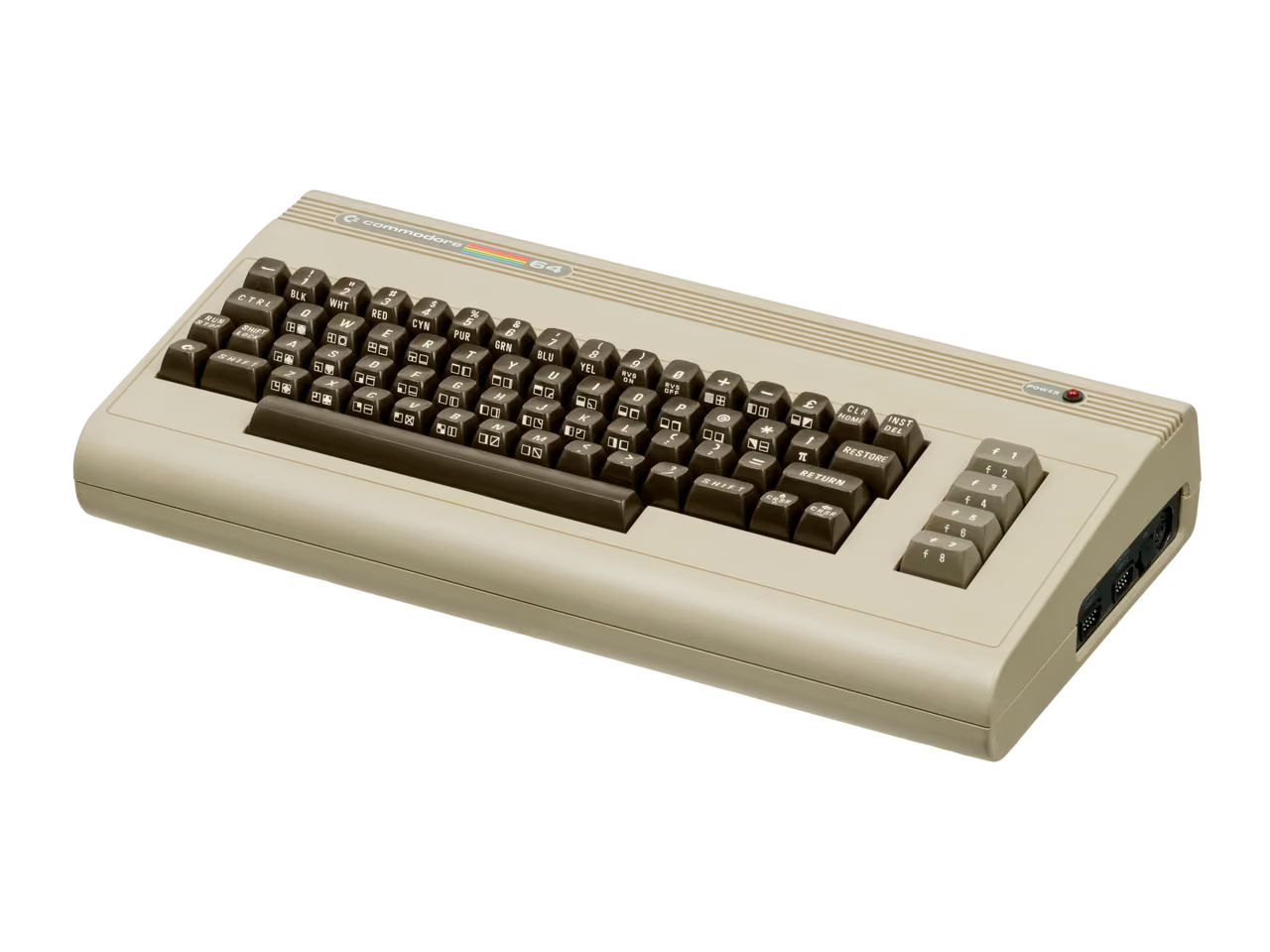
About this machine

A clock rate alone does not describe the Commodore 64. Its 6510 runs at whatever the video standard leaves it: 0.98525 MHz on PAL machines and 1.02273 MHz on NTSC ones. The VIC-II derives the system clock from the television color subcarrier. The two variants are the same computer running at slightly different speeds, and neither figure is a round megahertz. Memory is more subtle still: there are 64 KiB of RAM, 20 KiB of ROM and a 4 KiB I/O window, all inside one sixteen-bit address space, banked over each other through a port on the processor itself. Adding those capacities together would describe a machine that does not exist. Sound comes from the 6581 SID, which is not recorded as a component here because the catalog models processors, graphics and memory only.

Configuration

PAL

Europe

Component Role Count Clock Capacity
MOS Technology 6510 Derived from the PAL video timing, not from a processor speed grade. Main CPU 1 0.98525 MHz Nominal clock
MOS Technology VIC-II (6566/6567/6569) 6569 in PAL machines. Master of the system clock. GPU 1
Commodore 64 system RAM Shared with the video chip, which steals bus cycles during raster fetches. System memory 1 64 KiB shared
Commodore 64 system ROM Banked over the RAM rather than added to it. System memory 1 20 KiB shared

NTSC

North America

Component Role Count Clock Capacity
MOS Technology 6510 Derived from the NTSC video timing. Main CPU 1 1.02273 MHz Nominal clock
MOS Technology VIC-II (6566/6567/6569) 6567 in NTSC machines, with multiplexed addresses for dynamic RAM. GPU 1 8.18 MHz Nominal clock
Commodore 64 system RAM System memory 1 64 KiB shared
Commodore 64 system ROM System memory 1 20 KiB shared

Figures for the whole machine

Commodore 64: system figures

provisional A figure marked provisional is recorded but not accepted: its evidence is unsettled. It may rely on one source, an unconfirmed announcement, or a digit read from a damaged scan. The reason appears under the figure. The catalog shows the figure but never uses it in a multiplier. How records are judged.

Metric Value Evidence Basis Method Source
Clock frequency cpu 1.02273 MHz Confirmed Vendor-rated Nominal clock Stated by the vendor NTSC machines. The manual states this as the system frequency underlying its RS-232 baud-rate formulas. The same computer as the PAL machine, running 3.8% faster because the television standard differs. Neither figure is a round megahertz.
Clock frequency cpu 0.98525 MHz Confirmed Vendor-rated Nominal clock Stated by the vendor PAL machines. The manual states this as the system frequency underlying its RS-232 baud-rate formulas. Set by the video standard, not chosen for the processor: the VIC-II derives the system clock from the television timing. The 6510 part itself is rated for 1 MHz and 2 MHz operation.
Dhrystone MIPS cpu provisional 0.0205 DMIPS Reported Measured Benchmark run Published independently dhrystone 1.1 Run in the machine’s own ROM environment at a clock the table gives as 1 MHz, under Dhrystone version 1.1. The first Dhrystone figure in this catalog, and it is provisional because one collection states it and the policy asks for two independent sources. Read it as what it is: a score against the VAX-11/780, not a count of anything this machine executes. 0.0205 DMIPS does not mean twenty thousand instructions per second. It is also version 1.1, which was withdrawn precisely because compilers optimized it away, so it may not be divided by a version 2.1 figure; the benchmark identity refuses that automatically.
Clock frequency gpu 8.18 MHz Confirmed Vendor-rated Nominal clock Stated by the vendor The video dot clock of the NTSC machine, carried on pin 6 of the expansion port. A pixel rate, not a rate at which the VIC-II executes anything: the chip has no instructions to execute. It is recorded as the machine’s graphics clock because the manual makes it the primary clock of the whole machine, with the processor’s 1.02273 MHz derived from it rather than the other way round. Stated only for the NTSC machine: the guide is a North American publication and never gives the PAL dot clock.
Memory capacity whole-system 64 KiB Confirmed Derived Design capacity Computed here from figures the vendor stated Writable memory available to the processor, in both the PAL and the NTSC machine. Adds 1 memory-capacity figure obtained by design-capacity. Left out: 20 KiB of system ROM (read-only, so it is storage the machine reads from rather than memory it works in). A total is only as trustworthy as the decision about what belongs in it, so both the terms and the exclusions are named records.
4 documented absences
Commodore 64: system figures: documented absences
Metric Value Evidence Basis Method Source
Dhrystone MIPS per MHz cpu unknown Netlib gives the result at 1 MHz, which can describe either the PAL or NTSC clock after rounding. Its linked note names only C Power 2.8 with -DROPT. No source establishes a run clock precise enough to normalize the score per megahertz for either catalog configuration. Not stated Measured Benchmark run Published independently
Memory bandwidth memory unknown The Programmer’s Reference Guide describes the memory by capacity, by address map and by which chip may reach which part of it, and never states a transfer rate. Not stated Vendor-rated Theoretical peak Stated by the vendor Unknown, not not-applicable: the machine moves bytes and therefore has a rate. It could be computed — one byte per cycle, and the processor and the VIC-II take alternate cycles — but that arithmetic is this project’s, not the manual’s, and it would have to describe the interleaving rather than just state the product.
Sustained FP40 rate whole-system unknown The BASIC ROM uses five-byte floating-point numbers. No named, reproducible benchmark run has been admitted for this machine. Not stated Measured Benchmark run Published independently
Rated power consumption whole-system unknown The Programmer’s Reference Guide gives no power figure for the machine. The only wattage in it is a resistor rating on a schematic. Not stated Vendor-rated Rated power Stated by the vendor Recorded so the question is asked and answered rather than left blank. The Amiga 1200’s service manual has a specification table with a supply rating in it; this guide is a programming manual and has no such table, which is a fact about the document rather than about the computer.

Figures for its components

2 documented absences
MOS Technology 6510: documented absences
Metric Value Evidence Basis Method Source
Native instruction rate cpu unknown No acceptable source states one, and there is no single correct answer to state: 6502 instructions take between two and seven cycles depending on the instruction and its addressing mode, so an instruction rate exists only for a specific mix of instructions. Dividing the clock by one cycle per instruction — the usual shortcut to "about 1 MIPS" — describes no real workload. Not stated Measured Instruction mix Stated by the vendor
Peak FP32 rate cpu not applicable No floating-point hardware. The 6510 does decimal and binary integer arithmetic in an eight-bit accumulator; the Commodore 64's floating point is a software library in the BASIC ROM, which is not a property of the processor. Not stated Vendor-rated Theoretical peak Stated by the vendor
Commodore 64 system RAM
Metric Value Evidence Basis Method Source
Memory capacity memory 64 KiB Confirmed Vendor-rated Design capacity Stated by the vendor Dynamic RAM filling the whole sixteen-bit address space. Exactly 65 536 B: the manual's "64K" is a binary kilobyte. The ROM capacity is recorded separately and overlaps this address range rather than extending it, so the two must never be added.
Commodore 64 system ROM
Metric Value Evidence Basis Method Source
Memory capacity memory 20 KiB Confirmed Vendor-rated Design capacity Stated by the vendor BASIC, the KERNAL operating system and the standard character set. Banked over the RAM inside the same sixteen-bit address space, not added to it.

Derived figures and comparisons

Computed by this project rather than read from a source, and recomputed from their inputs on every build.

1.0380×

Formula
a ÷ b ratio v1
Inputs
  • commodore-64 Clock frequency: 1.02273 MHz
  • commodore-64 Clock frequency: 0.98525 MHz
Rounding
half-up , 5 significant digits

Compares clock-frequency at cpu scope, obtained by nominal-clock. Valid only within this comparability group, and reported to 5 significant digits — the precision of the least precise input.

65 536 B

Formula
a + b + … sum v1
Inputs
  • c64-system-ram Memory capacity: 64 KiB
Rounding
none , 5 significant digits

Adds 1 memory-capacity figure obtained by design-capacity. Left out: 20 KiB (read-only, so it is storage the machine reads from rather than memory it works in). A total is only as trustworthy as the decision about what belongs in it, so both the terms and the exclusions are named records.

Editorial notes

The release date is editorial context; the cited manual documents the machine without dating its launch. Every measurement attached to this system comes from that manual.

Sources

Back to top