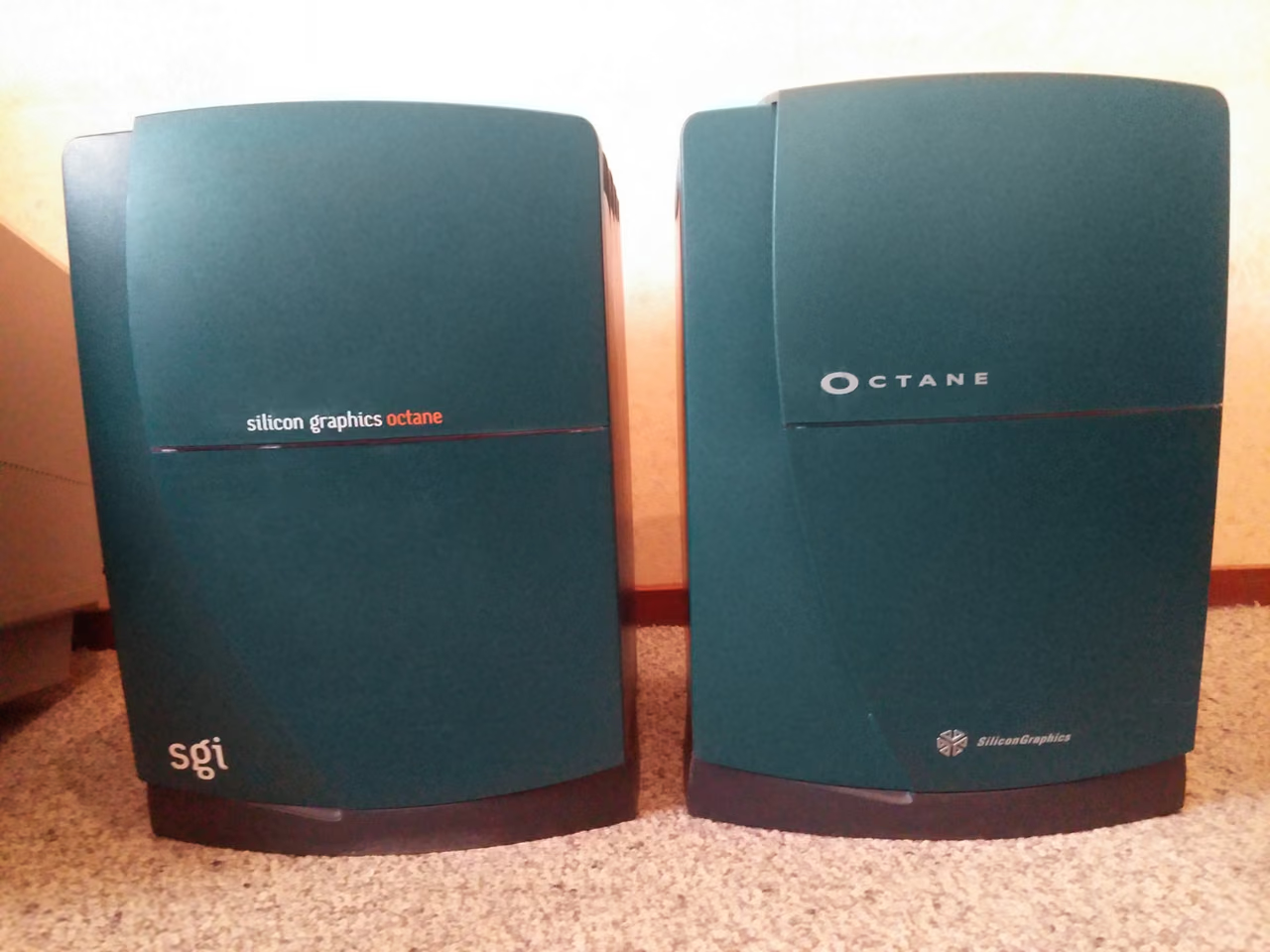
About this machine

The Octane is the first machine here with quoted benchmark results. Earlier records use design specifications, such as clock rates, memory sizes and instruction timings, because comparable benchmark results do not exist for those machines. SGI published SPEC CPU95 results for the Octane. They measure what the processor, the memory subsystem and the compiler achieve together on a named workload, so they are a different kind of number. The two SPEC results are not from the same machine. The CINT95 result used a single-processor Octane with 128 MB of memory; the CFP95 result used a two-processor Octane with 256 MB and an auto-parallelizing compiler. They are recorded against separate configurations.

Configuration

Octane 1X 250MHz R10k

Component Role Count Clock Capacity
MIPS R10000 Processor chip revision 3.1, with the R10010 floating-point chip at revision 0.0. Main CPU 1 250 MHz Nominal clock
SGI Octane main memory System memory 1 128 MiB

The configuration SGI published the CINT95 result on: 128 MiB of memory, IRIX64 6.4, MIPSpro C 7.2.

Octane 2X 250MHz R10k

Component Role Count Clock Capacity
MIPS R10000 Main CPU 2 250 MHz Nominal clock
SGI Octane main memory System memory 1 256 MiB

The configuration SGI published the CFP95 result on: 256 MiB of memory, IRIX64 6.4, MIPSpro Fortran 77 and 90 7.2 with the Auto Parallelizing Option.

Figures for the whole machine

Silicon Graphics Octane: system figures
Metric Value Evidence Basis Method Source
Clock frequency cpu 250 MHz Confirmed Vendor-rated Nominal clock Stated by the vendor MIPS R10000, processor chip revision 3.1, as reported in the SPEC result configuration.
Clock frequency cpu 250 MHz Confirmed Vendor-rated Nominal clock Stated by the vendor Both processors run at the same rate. The clock is per processor, not a total. Two processors at 250 MHz is not 500 MHz of anything. Clock frequency does not add across processors, which is exactly why the floating-point result obtained on this machine is recorded separately from the single-processor integer one.
SPEC CPU result, cint-base whole-system 13.0 Confirmed Measured Published SPEC result Stated by the vendor spec-cpu 95 , cint-base IRIX64 6.4, MIPSpro C Compiler 7.2, base flags -Ofast=ip27 -IPA:use_intrinsic with feedback-directed optimization. One 250 MHz R10000, 128 MiB of memory. SPEC fair use applies to any quotation of this figure. Base and peak are different comparability groups: base results are run with one flag set across all benchmarks, peak results allow per-benchmark tuning, and the two are never interchangeable. Comparable only with other CINT95 base results, never with CPU2000 or later suites. SPEC publishes no conversion between suite generations.
SPEC CPU result, cint-peak whole-system 13.6 Confirmed Measured Published SPEC result Stated by the vendor spec-cpu 95 , cint-peak As the base result, but with per-benchmark compiler flags. The full peak flag set is in the cited result file. SPEC fair use applies. A peak result is tuned per benchmark and is not comparable with a base result, including the base result for this same machine.
SPEC CPU result, cfp-base whole-system 25.5 Confirmed Measured Published SPEC result Stated by the vendor spec-cpu 95 , cfp-base IRIX64 6.4, MIPSpro Fortran 77 and 90 7.2 with the Auto Parallelizing Option. Two 250 MHz R10000 processors, 256 MiB of memory. SPEC fair use applies. A floating-point result is not comparable with an integer one: different benchmarks, different code, different comparability group. This result was also obtained on a two-processor machine with an auto-parallelizing compiler, so it is not a single-processor figure.
SPEC CPU result, cfp-peak whole-system 26.6 Confirmed Measured Published SPEC result Stated by the vendor spec-cpu 95 , cfp-peak As the base floating-point result, but with per-benchmark compiler flags. SPEC fair use applies. Peak and base are separate comparability groups, and this is a two-processor result.
Memory capacity whole-system 128 MiB Confirmed Vendor-rated Design capacity Stated by the vendor Memory fitted to the machine SGI published the CINT95 result on. The result file writes "128MB", which in this period and context means 128 MiB. It describes the tested configuration, not the maximum the Octane supported.
Memory capacity whole-system 256 MiB Confirmed Vendor-rated Design capacity Stated by the vendor Memory fitted to the machine SGI published the CFP95 result on.
3 documented absences
Silicon Graphics Octane: system figures: documented absences
Metric Value Evidence Basis Method Source
Memory bandwidth memory unknown The cited documents are published SPEC results, which describe the machine’s configuration and its scores and state no memory bandwidth. Not stated Vendor-rated Theoretical peak Published independently Unknown because of what this record is sourced from. Silicon Graphics quoted a bandwidth for the Octane’s crossbar in its own literature, and none of that literature is cited here. The machine is in the catalog on the strength of two SPEC submissions, which say what was fitted and how fast it ran the suite.
Sustained FP64 rate whole-system unknown SGIStuff reports a LINPACK result for an Octane with an R10000, but names neither the LINPACK revision nor the floating-point precision. The row cannot establish an FP64 benchmark result. Not stated Measured Benchmark run Published independently
Rated power consumption whole-system unknown A SPEC result reports the hardware and software configuration of the machine under test, not its power rating. SGI’s own hardware documentation for the Octane is not held by any archive this project may cite: what survives of SGI on the Internet Archive is brochures and price lists, and the Octane brochure of December 1999 states the supply voltage and no wattage at all. Not stated Vendor-rated Rated power Published independently The same limitation as the bandwidth, from the same two documents. A workstation of this size has a supply rating printed on it; no source here states it.

Figures for its components

MIPS R10000
Metric Value Evidence Basis Method Source
Peak FP32 rate cpu 500 MFLOP/s Confirmed Derived Theoretical peak Computed here from figures the vendor stated One R10000 at 250 MHz, both floating-point units issuing on every cycle. Computed here, not published anywhere. Nobody rated this processor in floating-point operations per second: a processor of 1996 was documented by what its units retire per cycle, and the manual says the adder and the multiplier each accept one operation every cycle and stops there. The multiplication is the derived claim this record names, with both constants cited to that manual. It is an upper bound twice over — every unit fed on every cycle, nothing stalling — and the same figure holds at double precision, because the manual gives the multiplier one repeat rate for both.

Derived figures and comparisons

Computed by this project rather than read from a source, and recomputed from their inputs on every build.

500 000 000 FLOP/s

Formula
clock × issue slots × FLOP per slot per clock peak-fp32-from-clock v1
Inputs
  • sgi-octane Clock frequency: 250 MHz
Constants
  • floating-point issue slots: 2 The adder and the multiplier are separate functional units and the manual gives each a one-cycle repeat rate, so two floating-point operations can start on every cycle. The divide and square-root units are excluded: the same passage gives them repeat rates of twenty to forty cycles, so they cannot contribute to a per-cycle peak.
  • floating-point operations per slot per clock: 1 One operation per unit per cycle, which is what a one-cycle repeat rate means. Deliberately not the two-per-lane convention used for a fused multiply-add on later graphics hardware: this manual describes an adder and a multiplier as separate units issuing separately, and counting each as two would double the answer on an assumption the document does not support.
Rounding
half-up , 3 significant digits

Multiplies a published clock by floating-point issue slots × floating-point operations per slot per clock, so it is what the documented hardware implies rather than a rate anybody published. Reported to 3 significant digits — the precision of the clock, since the counts are exact. It is a peak in the strictest sense: it assumes every unit is fed on every cycle and nothing ever stalls, which no real program achieves. Both constants are assumptions about the architecture, cited on this claim.

Editorial notes

Graphics are not modeled here. The Octane shipped with several different graphics subsystems, and the cited SPEC results do not identify which one was fitted; recording a guess would be worse than recording nothing. The release date is editorial context, not a figure the cited results carry. They state hardware availability of March 1998 for these two configurations.

Sources

Back to top