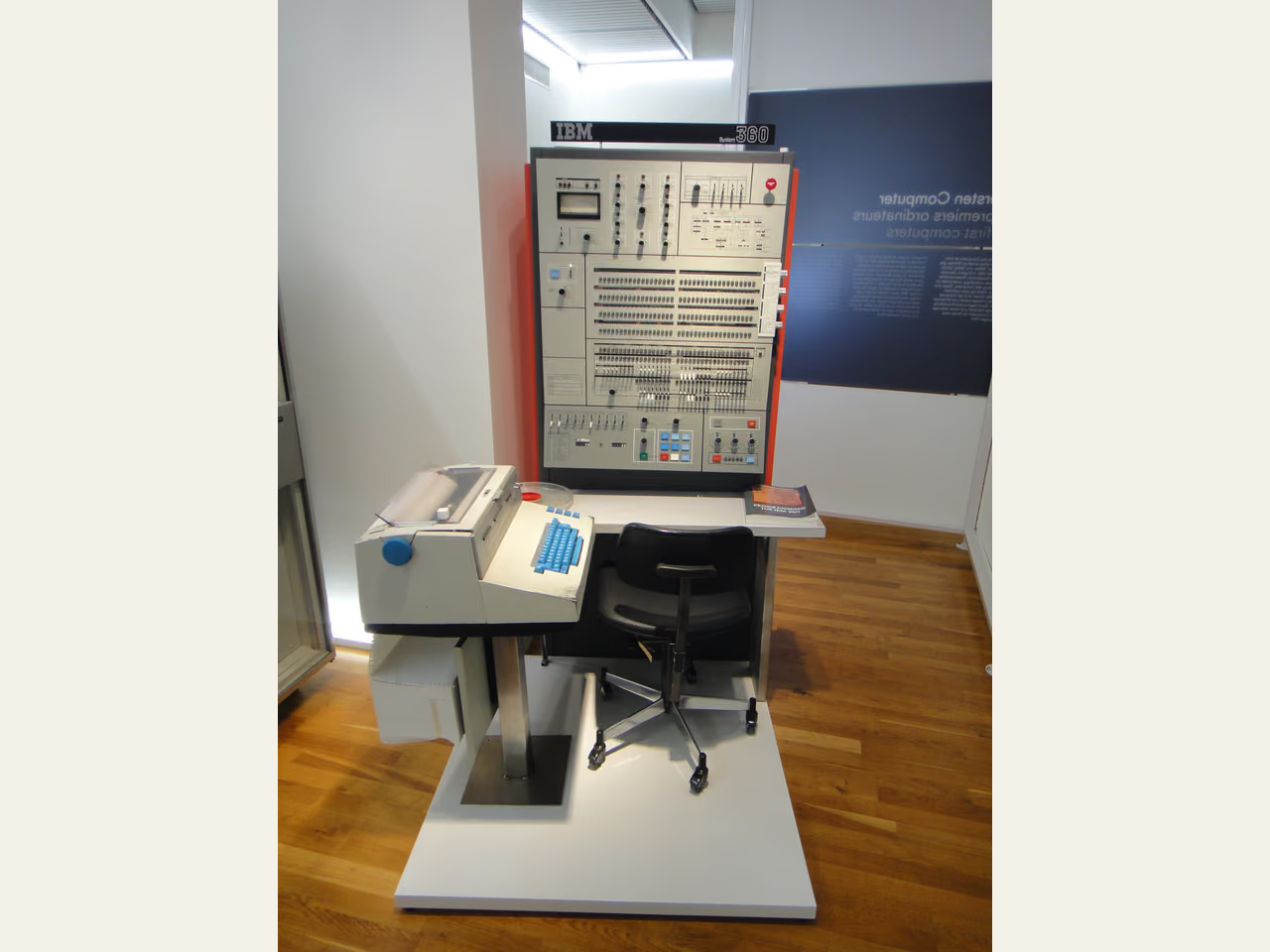
About this machine

IBM designed the Model 50 for commercial and scientific computing. Its universal instruction set combines the System/360 Standard, Commercial, and Scientific sets. The arithmetic unit handles decimal and hexadecimal arithmetic, including short and long hexadecimal floating-point operations.

Read-only storage holds the microprogram that controls processor data flow; application programs cannot address it directly. Core main storage holds programs and data, while local storage holds registers and scratchpad data. Channels overlap input/output with processor work. The selected F50 configuration includes the processor's main storage without optional external core storage or a display unit.

Software requirements depend on the operating system and release. IBM's DOS Release 24 manual specifies a minimum of 16 KiB of main storage, below this configuration's 65 536 B. DOS also requires suitable disk equipment, which is not included here. The OS/360 MFT guide for Release 21.7 requires at least 128 KiB of main storage, exceeding this configuration's capacity. These later manuals describe software requirements, not the software supplied at introduction.

Configuration

F50 with IBM 2050F processing unit

Component Role Count Clock Capacity
IBM 2050 Processing Unit Main CPU 1 unknown Nominal clock —
IBM 2050F Main Storage System memory 1 — 65 536 B

The F50 variant is documented in the functional manual's second edition. Optional external core storage and display units are outside this configuration.

Figures for the whole machine

IBM System/360 Model 50: system figures
Metric Value Evidence Basis Method Source
Memory bandwidth memory 2.0 MB/s Confirmed Derived Theoretical peak Computed here from figures the vendor statedMain-storage data transfers only; excludes parity bits and optional external core storage. Divides bytes transferred by one main-storage cycle by the published memory cycle time. The result is an interface ceiling inferred from the transfer width and cycle time. It is not measured application throughput: refresh, contention and wait states can consume cycles. Reported to 2 significant digits. That is the precision of the cycle time, because the bytes-per-cycle constant is exact.
Memory capacity whole-system 65 536 B Confirmed Vendor-rated Design capacity Stated by the vendor Program-addressable main storage in the selected F50 configuration. Excludes processor registers, read-only microprogram storage, channel-control storage inaccessible to programs, and optional external core storage.
3 documented absences
IBM System/360 Model 50: system figures: documented absences
Metric Value Evidence Basis Method Source
Clock frequency cpu unknown The checked documents state internal cycle durations, but do not identify a nominal CPU oscillator frequency. Not stated Vendor-rated Nominal clock Stated by the vendor
Clock frequency gpu not applicable The selected processing-unit configuration has no fitted graphics processor. The optional display unit is outside its scope. Not stated Vendor-rated Nominal clock Stated by the vendor
Rated power consumption whole-system unknown The planning manual states apparent power in kVA and heat output, but does not give configured system consumption in watts. Not stated Vendor-rated Rated power Stated by the vendor

Figures for its components

1 documented absence
IBM 2050 Processing Unit: documented absences
Metric Value Evidence Basis Method Source
Peak FP32 rate cpu unknown Native short hexadecimal floating-point arithmetic is supported. The checked instruction timings are operand-dependent weighted averages, not a theoretical peak operation rate. Not stated Vendor-rated Theoretical peak Stated by the vendor
IBM 2050F Main Storage
Metric Value Evidence Basis Method Source
Memory capacity memory 65 536 B Confirmed Vendor-rated Design capacity Stated by the vendor
Memory cycle time memory 2.0 µs Confirmed Vendor-rated Nominal cycle time Stated by the vendorA main-storage read/write cycle; the shorter ROS and local-storage cycles are separate.

Derived figures and comparisons

Computed by this project rather than read from a source, and recomputed from their inputs on every build.

2 000 000 B/s

Formula
bytes per memory cycle ÷ memory cycle time memory-bandwidth-from-cycle-time v1
Inputs
  • ibm-2050f-main-storage Memory cycle time: 2.0 µs
Constants
  • bytes transferred by one main-storage cycle: 4 The Main Storage section states that each read/write cycle accesses four bytes. This is an exact transfer width, excluding parity bits.
Rounding
half-up , 2 significant digits

Divides bytes transferred by one main-storage cycle by the published memory cycle time. The result is an interface ceiling inferred from the transfer width and cycle time. It is not measured application throughput: refresh, contention and wait states can consume cycles. Reported to 2 significant digits. That is the precision of the cycle time, because the bytes-per-cycle constant is exact.

Editorial notes

The introduction date follows IBM's historical comparison table. It is an announcement date, not a first-shipment date for the selected configuration.

Sources

Back to top